CMYK Halftone Patterns: A Practical Guide to Elevating Your Craft Projects
When you are diving into the world of digital crafting, design, or print-on-demand businesses, the difference between a mediocre project and a professional-looking one often comes down to texture and detail. This is where CMYK Halftone Seamless Patterns become an indispensable asset. If you have ever struggled with flat, lifeless designs that fail to capture attention on social media or in physical print, understanding how to leverage high-quality halftone textures can be a game-changer.
Halftoning is not just a retro aesthetic choice; it is a fundamental printing technique that uses dots of varying sizes to create the illusion of continuous tone imagery. When applied as a seamless pattern, it adds depth, rhythm, and visual interest to backgrounds without overwhelming the main subject. Whether you are creating gift wrapping for a boutique, designing greeting cards for a small business, or simply adding flair to your personal junk journals, these patterns offer a versatile solution. However, not all digital assets are created equal. Choosing the right resources requires knowing what to look for—and more importantly, what to avoid.
Why CMYK Halftone Patterns Are Essential for Modern Design
The appeal of CMYK (Cyan, Magenta, Yellow, Key/Black) color models lies in their direct relevance to physical printing. Unlike RGB, which is designed for screens, CMYK ensures that the colors you see on your monitor translate accurately to paper, fabric, or vinyl. When you use a seamless pattern generated in this color space, you are essentially pre-optimizing your design for real-world application.
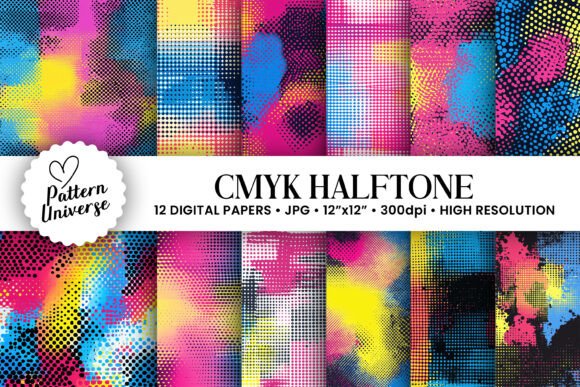
For creators working on projects like tumbler wraps, wall art, or scrapbook pages, consistency is key. A "seamless" pattern means that when tiled, there are no visible breaks or awkward edges. This continuity allows for scalable designs that look good whether they are printed on a tiny 3x5 card or a large poster. The specific inclusion of 12 Digital Papers within 1 zip file provides variety without cluttering your workflow. You get a curated collection that maintains a cohesive style while offering enough variation to suit different moods and occasions.
Common Pitfalls in Selecting and Using Digital Patterns
Even experienced designers can fall into traps when sourcing or applying digital assets. Understanding these common mistakes can save you time, money, and frustration.
Ignoring Resolution and File Size
One of the most critical errors is downloading low-resolution images and expecting them to hold up in print. A common misconception is that a file looks sharp on a smartphone screen, so it will look sharp on a printed card. This is rarely true. For high-quality printing, especially for items like greeting cards or wall art where viewers may inspect details closely, resolution matters immensely.
Ensure that any pattern you download meets the standard 300dpi (dots per inch). Lower resolutions result in pixelation, blurriness, and jagged edges when scaled up. Furthermore, check the pixel dimensions. A file size of 3600 x 3600 pixels equates to a 12-inch by 12-inch square at 300dpi. This is the industry standard for scrapbooking and many craft applications. If a seller advertises "high quality" but does not specify DPI or pixel dimensions, proceed with caution. You risk having to recreate the work from scratch if the files are too small for your intended use.
Neglecting Color Mode Compatibility
As mentioned, CMYK is crucial for print. However, some digital papers are sold in RGB format only. While you can convert RGB to CMYK in software like Photoshop or Canva, this conversion often leads to duller, less vibrant colors. Cyan and magenta can shift significantly, making bright blues turn muddy or vibrant pinks lose their pop. By choosing patterns explicitly described as CMYK or optimized for print, you bypass this color-shift issue entirely. It ensures that the halftone dots render exactly as the artist intended, preserving the subtle gradients and contrasts that define the halftone effect.
Overlooking Seamlessness Verification
A pattern labeled "seamless" should tile perfectly. Unfortunately, some sellers upload images that appear seamless at a glance but reveal obvious seams when repeated across a larger canvas. Before purchasing or committing to a design, test the pattern. In most design software, you can create a pattern swatch or simply copy and paste the image side-by-side. Look for hard lines, mismatched edges, or abrupt changes in dot density at the boundaries. A truly seamless pattern allows for infinite repetition without visual interruption, which is vital for backgrounds in invitations or tumbler wraps where the design might wrap around corners.
Maximizing the Utility of Your Digital Assets
Once you have secured a high-quality set of 12 CMYK Halftone Seamless Patterns, how do you integrate them effectively? The versatility of these files extends far beyond simple background fills.
- Gift Wrapping and Packaging: Use the patterns as full-page backgrounds for custom gift tags or wrapping paper. The halftone texture adds a sophisticated, tactile feel even in digital previews, increasing perceived value.
- Greeting Cards and Invitations: Layer text over these patterns. Because halftones are typically monochromatic or duotone, they provide excellent contrast for typography without competing for attention. Ensure your text color contrasts sharply with the dominant tones of the pattern.
- Tumbler Wraps: These patterns are ideal for sublimation printing. The 12x12 inch size is easily scalable to fit standard tumbler dimensions. The seamless nature ensures that when the design is wrapped around the cylinder, the transition is invisible.
- Junk Journals and Scrapbooking: Print these patterns on cardstock or specialty paper. They serve as perfect backdrops for photos, stickers, and handwritten notes. The consistent 300dpi resolution ensures that prints remain crisp even after multiple handling sessions.
- Wall Art and Digital Frames: Scale the 3600x3600 pixel files up for larger formats. Since halftone patterns are abstract, they maintain their integrity at various scales, making them suitable for minimalist modern decor.
Evaluating Quality Before You Buy
To ensure you are getting the best value, always review the product description for technical specifications. Look for clear mentions of:
- Resolution: Confirm 300dpi.
- Dimensions: Verify 3600 x 3600 pixels (or equivalent aspect ratio).
- Format: Most commonly JPG or PNG for ease of use, though AI or EPS files offer scalability for vector-based workflows.
- Color Profile: Prefer CMYK or sRGB if you are unsure about your printer's capabilities, but prioritize CMYK for professional print results.
By focusing on these technical details, you protect yourself from buying unusable assets. Remember, the goal is efficiency and quality. Investing in a well-curated pack of 12 high-resolution, seamlessly tiled patterns saves you the hours it would take to create similar textures from scratch. It allows you to focus on the creative aspects of your project—whether that’s layout, typography, or concept—rather than troubleshooting poor file quality.
Whether you are a hobbyist looking to enhance your scrapbooks or a small business owner aiming to produce premium merchandise, these digital papers offer a robust foundation. They bridge the gap between digital convenience and physical professionalism. Take the time to verify the specs, test the seams, and appreciate the nuance of the halftone technique. Your customers, friends, and clients will notice the difference in quality, and your creative process will be smoother and more enjoyable as a result.